Open Data Ensemble
ODE is pronounced like "code", without the "C."
Open Data Ensemble (ODE) is a comprehensive platform for mobile data collection and synchronization. Built for researchers, health professionals, implementers, and developers, ODE provides a robust solution for designing forms, managing data securely, and synchronizing seamlessly across devices, even in offline conditions.
The source code for the pre-release version of ODE is now publicly available. While we're working toward the full 1.0 release, we welcome anyone willing to help with testing, development, or getting involved in the project.
Try the pre-release: Install Formulus on Android
Get involved: Reach out to us at [email protected] - we'd love to hear from you!
Source Code: Our monorepo on GitHub contains the source code for all components. Visit our repository: https://github.com/OpenDataEnsemble/ode
The Problem ODE Solves
Traditional data collection tools often have limitations:
- No offline support - Without internet, collection stops
- Complexity - Building forms requires technical expertise
- Inflexibility - Customization is difficult and expensive
- Lock-in - Data is trapped in proprietary systems
- Cost - Enterprise solutions are prohibitively expensive
How ODE Works
ODE provides an integrated system for the complete data lifecycle:
┌──────────────┐      ┌──────────────┐      ┌──────────────┐
│   Collect    │  ──► │    Sync      │  ──► │   Analyze    │
│   Data       │      │   Offline    │      │   & Export   │
└──────────────┘      └──────────────┘      └──────────────┘
    Formulus         WatermelonDB +         Parquet Export
    (App)           Synkronus (Server)      (Your Tools)
What is ODE?
ODE is a modern toolkit that simplifies mobile data collection through:
- Simplicity & Efficiency: Quickly create complex, validated forms using a powerful yet intuitive JSON-based approach
- Advanced Offline Sync: Reliable and conflict-resilient synchronization powered by WatermelonDB
- Flexible & Extensible UI: Customize form presentation and interaction effortlessly with JSON Forms, enabling rich, interactive user experiences
- Cross-platform Support: Applications run on Android, iOS, and web platforms
Current Members of the Ensemble
Here's an overview of the current members of the ensemble:
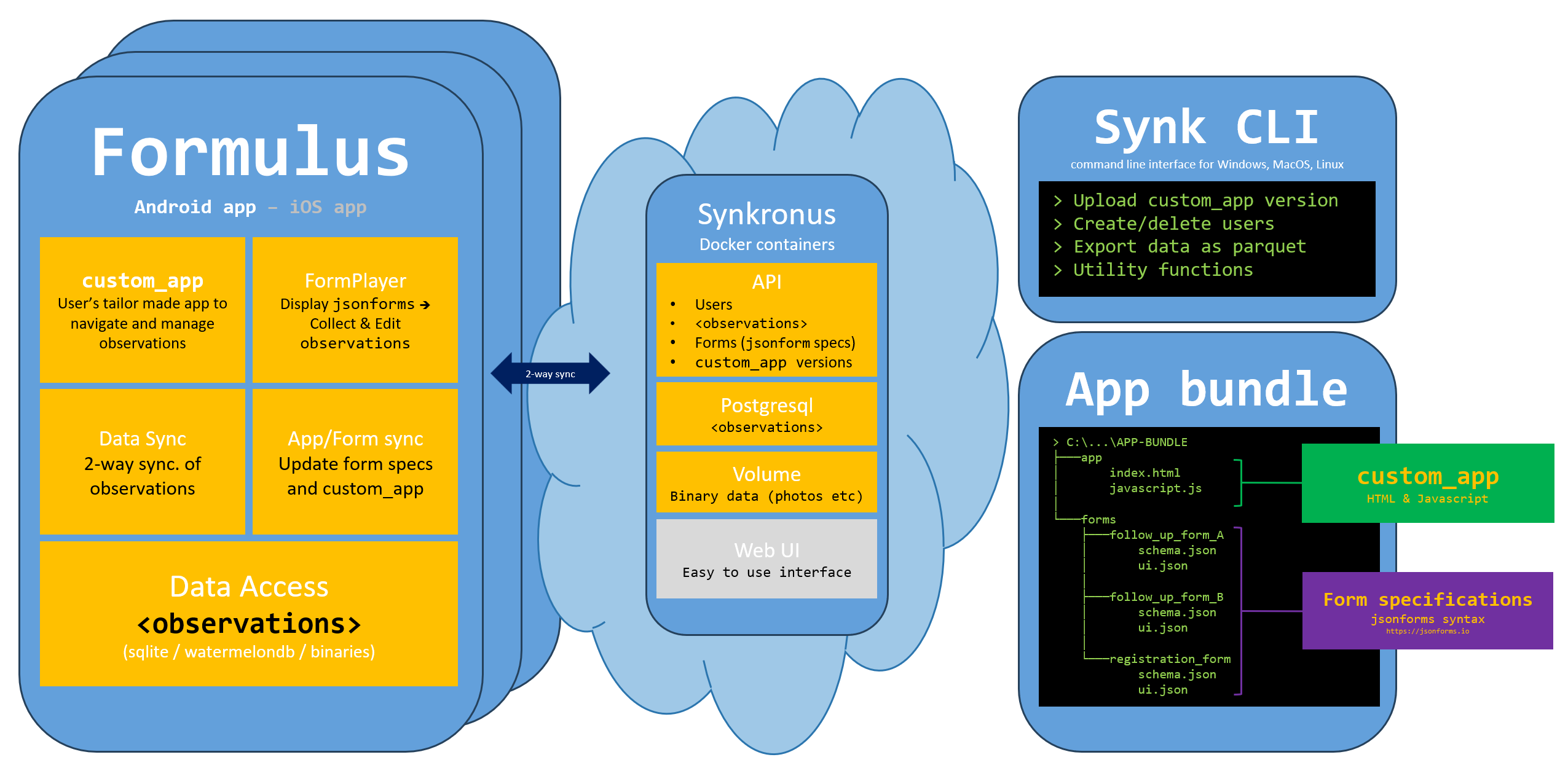
- formulus: The Android and iOS app for data collection and form interaction.
- synkronus: The robust server backend managing synchronization and data storage.
- synkronus-cli: Command-line interface for convenient server management and administrative tasks.
Key Components
ODE consists of four main components that work together:
| Component | Description | Technology |
|---|---|---|
| Formulus | Mobile application for Android and iOS | React Native |
| Formplayer | Web-based form rendering engine | React |
| Synkronus | Backend server for data synchronization | Go |
| Synkronus CLI | Command-line utility for administration | Go |
Core Capabilities
Form Design
Create sophisticated forms using JSON schema definitions. ODE supports various question types including text, numbers, dates, selections, multimedia capture, GPS coordinates, and custom renderers.
Offline Functionality
Work seamlessly in areas with unreliable connectivity. Data is stored locally and synchronized when network connectivity is available.
Data Synchronization
Reliable bidirectional synchronization ensures data consistency across devices and servers, with conflict resolution built into the protocol.
Custom Applications
Build custom applications that integrate with the ODE platform, allowing for specialized workflows and user interfaces.
Getting Started
New to ODE? Start with our Getting Started guide to understand the platform and begin your first project.
For developers looking to contribute or extend ODE, see the Development section for architecture details and contribution guidelines.
Documentation Structure
This documentation is organized to help you find information quickly:
- Getting Started: Introduction, installation, and basic concepts
- Using ODE: Practical guides for creating forms and managing data
- Guides: Step-by-step workflows for form design, custom apps, and deployment
- Reference: Complete API documentation and configuration options
- Development: Architecture details and contribution guidelines
- Community: Support resources and examples
Next Steps
- Read Why ODE? for a detailed overview
- Follow the Installation guide to set up your environment
- Create your first form to see ODE in action
- Explore the API Reference for technical details